
If you ask most anglers where they’re headed this weekend, chances are you’ll hear the name of the same lake they’ve fished for years.
There’s nothing wrong with that. Familiar water builds confidence. You know where the boat ramps are, where the hazards are, and maybe even where a few fish live.
But over the last several years, Danielle and I have found ourselves doing something different. We’ve started making it a point to fish new water whenever we can.
Not because our favorite lakes stopped producing, but because every unfamiliar lake teaches us something.
Every body of water has its own personality. Some are dominated by shallow weeds. Others are full of rock, timber, current, or expansive flats. You can’t approach every lake with the same game plan and expect the same results. That’s what makes fishing so addictive. Every launch is a new puzzle waiting to be solved.
I’ll admit, the first hour on a new lake can be frustrating. You’re second-guessing every decision. Was that point worth fishing? Should we have started deeper? Is there even bait in this bay?
Years ago, those questions would have made me run all over the lake, hoping to stumble into fish. Now we’ve learned to slow down. Instead of trying to fish everything, we spend more time observing than casting.
Before we even make the first cast, we’re looking at the weather. Which way has the wind been blowing? Has there been a cold front? Are we dealing with bright skies or heavy cloud cover? Those details start building a picture before the trolling motor ever hits the water.
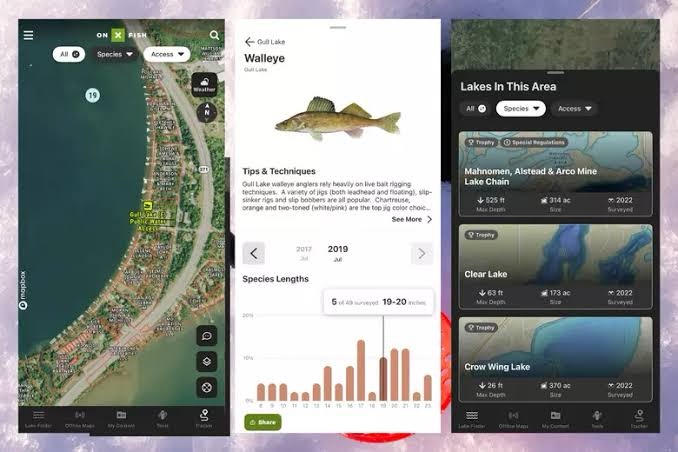
Then we study the map—not looking for a magic waypoint, but looking for areas that make sense. We want places that offer fish options. Deep water nearby. Structure. Feeding opportunities. Transitions. The more reasons fish have to use an area, the more likely it is to produce.
One thing we’ve stopped doing is getting emotionally attached to a spot.
Just because a reef looks perfect doesn’t mean it holds fish today. We’ve learned that it’s okay to leave. Fish tell you pretty quickly whether you’re in the right neighborhood. If the signs aren’t there, don’t force it.
Some of our best fishing days have actually started with failure.
We’ve struck out on the first few locations, questioned our decisions, and wondered if we were completely off. Then one small adjustment—moving a little deeper, following the wind, or changing presentations—changed the entire day.
Those moments are why we keep exploring.
Fishing new water has also made us better on the lakes we already know. Instead of relying on memories from years past, we’ve learned to trust what the conditions are telling us today. Fish don’t care where you caught them last July.
They care about current conditions.
That’s probably the biggest lesson new water teaches you.
It forces you to think instead of simply repeating yesterday’s pattern.
As content creators, exploring new lakes has another benefit. Every trip gives us a fresh story to tell. New scenery. New challenges. New people. Even when the fishing is tough, there’s almost always something worth sharing. Sometimes the best memories don’t come from the biggest fish—they come from figuring something out together after hours of trial and error.
Some of our favorite conversations have happened while idling across an unfamiliar lake before sunrise. Coffee in hand, maps open, wondering what the day might bring. There’s something exciting about not knowing what’s around the next point.
That’s what keeps us coming back.
It’s easy to chase numbers. Bigger fish. Bigger bags. More followers. But some of the most rewarding days we’ve spent outdoors didn’t end with a full livewell or a hero photo. They ended with a new lesson, a little more confidence, and another lake we’d gladly come back to someday.
So if you’ve been thinking about trying a new lake this summer, consider this your sign.
Launch the boat.
Accept that you might make a few wrong decisions.
Learn something.
And remember that becoming a better angler isn’t about memorizing spots—it’s about learning how to read the water wherever you go.
We’ll see you on the next one.
– Max & Danielle
Burley Outdoors
 Burley Outdoors
Leave a comment