
Burley Outdoors | October 15, 2026
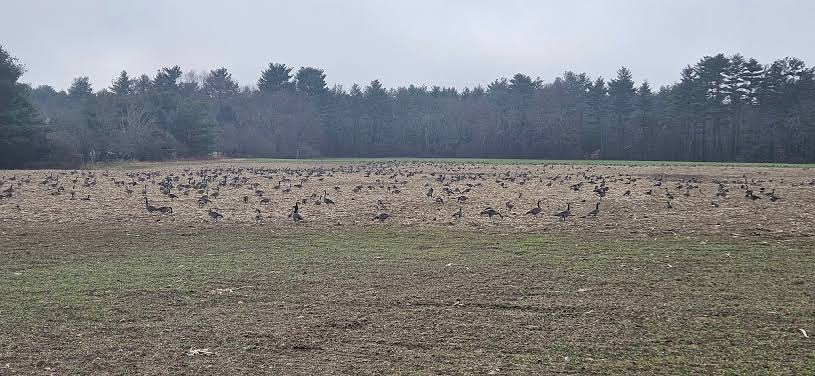
There’s a special kind of frustration that comes with finding a field full of geese, getting excited about the opportunity, and then realizing you have absolutely nowhere to hide.
It’s one of those situations where you almost wish you hadn’t found the birds in the first place.
You did everything right. You put in the windshield time, located the birds, watched them feed, figured out where they’re coming from, and started putting together a plan. You’ve got a great idea of what the birds want to do, and you’re confident they’re using the field consistently.
Then you actually look at the field.
It’s harvested beans.
Not just any harvested beans, either. The kind where the farmer has done such a good job that there isn’t a single piece of vegetation standing taller than your boot.
No grass. No weeds. No ditch cover. No meaningful terrain changes.
Just a giant, flat, brown field with a bunch of geese feeding right in the middle of it.
And suddenly, what looked like a fantastic hunting opportunity becomes a whole lot more complicated.
This is one of the situations Danielle and I have been thinking through this fall. We’ve spent a considerable amount of time improving our decoy spreads, organizing equipment, and figuring out how to become more efficient hunters. But none of those improvements completely solve one of the oldest problems in waterfowl hunting.
You can have the best decoys in the world, but if the birds can see you, none of it matters.
And as October progresses, that problem only becomes more challenging.
The Field Changes, but the Birds Still Want to Be There
Early-season field hunting can be a completely different experience from what we encounter later in the fall.
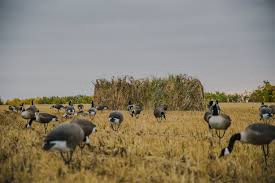
In September, there’s often still plenty of vegetation around. Field edges have tall grass, crops are standing, and the landscape offers a variety of natural hiding opportunities.
As harvest progresses, those options begin disappearing.
Corn gets chopped or combined. Beans come off. Grass dies back. Farmers work fields. What used to be a landscape full of potential concealment gradually turns into miles of open ground.
Meanwhile, geese continue using those agricultural fields because the food is still there.
And that creates an interesting problem.
The birds are perfectly comfortable standing in the middle of an open field. They have excellent visibility, plenty of room to land, and a clear view of anything approaching.
Unfortunately, those same characteristics make the field incredibly difficult for us to hunt.
A flock of geese doesn’t need to hide from itself.
We do.
That’s something I think we occasionally overlook when we’re planning a hunt.
We become so focused on where the birds are landing that we forget to evaluate whether we can realistically hunt that location without being exposed.
And sometimes, the answer is no.
That’s a tough thing to accept when you’ve spent hours finding birds.
But recognizing that a field is difficult to hunt is a lot better than pretending it isn’t and ruining an opportunity.
The Temptation to Hunt Right on the X
Every waterfowl hunter knows the value of being on the X.
If you’ve watched 150 geese land in the same part of a field for three consecutive mornings, there’s a pretty compelling argument for putting your decoys exactly where those birds want to be.
You’re not trying to convince them to change their routine.
You’re simply waiting for them to return.
In theory, that’s about as good as field hunting gets.
But what happens when that spot offers absolutely no concealment?
Do you put layout blinds directly in the bean stubble and hope you can brush them well enough?
Do you build a low-profile hide from whatever vegetation you can find?
Do you bring an A-frame and attempt to create something that looks natural?
Or do you abandon the X entirely and move toward the nearest available cover?
There isn’t one correct answer.
And that’s what makes these situations so interesting.
Every option comes with a tradeoff.
Hunting directly on the X gives us the advantage of location, but it might force us into a hide that birds can easily identify.
Moving toward natural cover gives us a better chance of disappearing, but now we’re asking the birds to change where they intended to land.
Neither situation is ideal.
The challenge is figuring out which compromise gives us the best opportunity.
And I think that decision deserves considerably more thought than simply dragging a blind into the field and hoping for the best.
When Natural Cover Is 200 Yards Away
Let’s imagine a situation we’ve been evaluating recently.
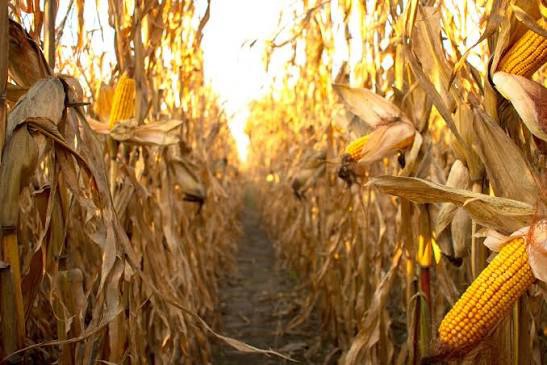
There’s a harvested beanfield with geese consistently feeding in the open. Along one edge is a strip of standing corn that offers excellent natural concealment.
The problem?
The corn is a couple hundred yards away from where the birds actually want to land.
That’s a substantial distance when you’re trying to convince geese to finish in shotgun range.
Especially if they’ve already established a feeding pattern.
Now we have a decision to make.
Do we move into the standing corn, accept the distance, and try to attract the birds toward our location?
Or do we attempt to hide closer to the X, knowing concealment is going to be much more difficult?
My initial instinct is almost always to prioritize the hide.
I’ve become increasingly convinced that poor concealment ruins more promising waterfowl hunts than almost anything else.
We’ve all watched birds approach a spread, look interested, and then suddenly slide away for no obvious reason.
Sometimes it’s the decoys.
Sometimes it’s the wind.
Sometimes it’s hunting pressure.
But I think there are plenty of occasions when the birds simply identify something about our setup that doesn’t belong.
A poorly brushed blind.
A shiny face.
Movement inside the hide.
An unnatural clump of vegetation in the middle of an otherwise empty field.
Something isn’t right.
And the birds decide they don’t want anything to do with it.
That’s why standing corn is so appealing.
It provides a natural background that already belongs in the landscape. We don’t have to create an artificial hiding place in the middle of a bare field.
We can disappear into something the birds are accustomed to seeing.
But that doesn’t automatically mean it’s the right decision.
Because 200 yards is still 200 yards.
Can We Actually Change Where the Birds Want to Land?
This is where I think we need to be realistic about what our decoy spreads can accomplish.
A good spread can absolutely influence where geese land.
We’ve seen it happen.
Birds might approach a field with one location in mind, notice our decoys, and adjust their approach.
Sometimes they make a small correction.
Sometimes they swing across the field and commit to the spread.
And sometimes they completely ignore us and land exactly where they’ve been landing all week.
That’s the part we can’t control.
We can create an attractive setup, but we can’t force birds to abandon a location they’re already comfortable using.
And the farther we move away from that location, the more we’re relying on the decoys to change their minds.
This is particularly important when we’re hunting local geese that have spent weeks learning the area.
Those birds know the fields.
They know where they’ve been feeding.
They know which locations have been safe.
And depending on how much pressure they’ve experienced, they may be increasingly reluctant to investigate something unfamiliar.
That’s why I don’t automatically believe that putting out more decoys solves the problem.
If birds are consistently landing 200 yards away, adding another dozen full bodies might help create a more visible spread.
But it doesn’t necessarily address why they prefer the other location.
Maybe they’re feeding on a particular concentration of waste grain.
Maybe the field has a slight rise that makes them more comfortable.
Maybe they’re following a specific approach that naturally carries them toward the middle.
Or maybe they’ve simply developed a routine.
The question isn’t whether our spread looks good.
It’s whether it gives the birds a compelling reason to change what they were already planning to do.
And sometimes, it won’t.
Big Spreads Versus Small, Natural Setups
This is where our Dave Smith Decoy spread has made things particularly interesting.
We’ve invested heavily in building a realistic collection of Giants and Maximas, and it’s been one of the best decisions we’ve made for our waterfowl hunting.
The spread has already helped us kill a pile of birds this season.
But perhaps the biggest advantage isn’t simply how realistic the decoys look.
It’s the flexibility they give us.
We can build a relatively large feeding spread with plenty of different body postures, or we can scale things down and create something that looks like a small group of geese naturally feeding together.
Both approaches have their place.
And when we’re dealing with a difficult field, deciding between them becomes especially important.
If we’re hiding along the edge of standing corn, a larger spread might help make our location more noticeable and create the appearance of a group of geese feeding along that edge.
We could use feeders to establish the primary activity, mix in some upright birds, and position the spread to encourage approaching geese to finish within range.
The idea would be to create enough attraction that birds consider joining our group rather than continuing toward their usual landing area.
But there’s a downside.
A large spread takes time to set up and pick up. It also creates a much bigger visual footprint.
If the geese are accustomed to seeing small groups feeding in that particular field, suddenly encountering a massive concentration of birds along the corn might not look particularly natural.
That’s where a smaller setup becomes interesting.
Instead of trying to overwhelm birds with numbers, we could create a compact, believable group near the cover.
Maybe a dozen carefully positioned full bodies.
Maybe fewer.
The goal would be to make the spread look like geese that have naturally landed, found something worth feeding on, and settled into the field.
Not a giant attraction designed to pull birds from every direction.
Neither approach is universally better.
And that’s something I think gets lost in discussions about decoy numbers.
The best spread isn’t necessarily the biggest or smallest. It’s the one that makes the most sense for the birds, the location, and the conditions.
That’s what we’re trying to get better at understanding.
Why I Keep Coming Back to Small Groups
There’s something about a compact, realistic goose spread that I really like.
Maybe it’s because we’ve spent so much time trying to eliminate anything unnatural from our setups.
Maybe it’s because our DSD decoys give us the confidence to rely on realism rather than sheer numbers.
Or maybe it’s simply because smaller spreads are easier to manage.
Whatever the reason, I’ve become increasingly interested in seeing how much we can accomplish with fewer decoys when everything else is right.
A small spread forces us to pay attention to details.
The body postures need to make sense.
Spacing becomes more important.
The landing area needs to be intentional.
And we have to be particularly careful about concealment because we don’t have a massive group of decoys helping draw attention away from the hide.
But there’s another advantage.
Mobility.
If we determine that the birds are consistently favoring a different portion of the field, moving a dozen decoys is considerably easier than moving five dozen.
That flexibility matters.
Especially when we’re hunting with a small group and trying to keep the entire operation simple.
I don’t want to spend two hours setting up a giant spread only to realize the birds are approaching from an angle we didn’t anticipate.
Sometimes being able to make quick adjustments is more valuable than having every decoy we own in the field.
The Hide Has to Match the Landscape
One thing I want to emphasize is that concealment isn’t just about covering a blind with vegetation.
It’s about making the entire setup belong in its surroundings.
A layout blind covered in fresh green grass might look fantastic in the garage.
Put that same blind in a completely brown beanfield in October, and it might stand out like a sore thumb.
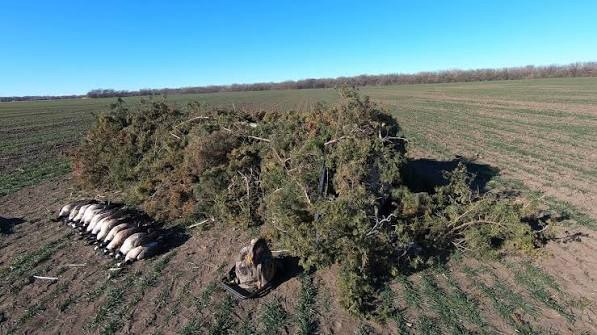
Likewise, a giant pile of corn stalks in the middle of a field where every other stalk has been removed can create a suspicious-looking mound.
The material itself might be natural.
But the shape and location aren’t.
That’s why I think we need to evaluate the entire scene rather than just the blind.
What does the field look like from the direction the birds are approaching?
Are there natural variations in color?
Are there low spots, drainage areas, or patches of remaining vegetation?
Can we use terrain to reduce our profile?
Would a small, carefully brushed layout blend better than a larger frame blind?
And perhaps most importantly, are we trying to hide somewhere that simply doesn’t offer a realistic opportunity?
Sometimes we spend so much time trying to make a particular blind work that we forget to ask whether we should be using that blind in the first place.
A low-profile layout might be the best choice in one situation.
A carefully brushed A-frame could be perfect along a grassy edge.
Standing corn might offer the most natural concealment available.
But the equipment needs to match the location.
Not the other way around.
And whatever we choose, we need to evaluate it from the birds’ perspective.
That means stepping away from the hide and looking back at it from different angles.
A blind that disappears when you’re standing beside it can look completely different from 50 yards away.
And geese approaching from above have an even different view.
That’s why I’m increasingly interested in keeping our hides low, natural, and as unobtrusive as possible.
The less we have to explain away, the better.
Wind Direction Can Make the Decision for Us
There’s another factor that can completely change how we approach a difficult field.
Wind.
Let’s go back to that harvested beanfield with standing corn along one edge.
Depending on the wind direction, that corn might provide an excellent place to hide while still allowing us to set an attractive landing zone.
Or it might create a situation where birds are naturally approaching from behind us, flying over the hide, and landing well beyond shotgun range.
Neither the corn nor the field has changed.
Only the wind.
But that can make an enormous difference.
Geese generally prefer to land into the wind when conditions allow. That doesn’t mean they’ll always approach exactly the way we expect, but it’s an important consideration when deciding where to position a spread.
I want to think about where the birds will be coming from, how they’ll turn into the wind, and where they’re most likely to finish.
If the wind naturally encourages them to approach the corn edge and land in front of us, that might be a very huntable situation.
If it encourages them to approach from the opposite direction and land farther into the field, we might be fighting an uphill battle.
And sometimes the best solution isn’t changing the spread.
It’s waiting for a different wind.
That’s a difficult decision when you know birds are using the field and you have permission to hunt it.
But hunting the wrong wind can turn an excellent opportunity into a frustrating morning.
And if we pressure those birds without creating a legitimate chance to finish them, we may make the next hunt more difficult.
That’s a tradeoff worth considering.
Sometimes the Smartest Hunt Is the One You Don’t Make
This is probably the hardest lesson for me.
I’m not particularly good at finding a bunch of geese and deciding to leave them alone.
If I’ve spent hours scouting and finally locate a group of birds, I want to hunt them.
That’s the whole reason we’re out there, right?
But the more I think about long-term success, the more I realize that not every group of birds needs to become tomorrow morning’s hunt.
Sometimes the location isn’t right.
Sometimes the wind isn’t right.
Sometimes the concealment options are terrible.
And sometimes we simply don’t have a realistic way to hunt the birds without educating them.
That’s okay.
We can keep watching them.
Maybe they shift to a different field.
Maybe a weather change creates a better opportunity.
Maybe we identify another location they’re using that offers better concealment.
Or maybe we eventually decide that the field isn’t worth hunting.
None of those outcomes means the scouting was wasted.
In fact, I think recognizing when not to hunt can be one of the most valuable skills we develop.
We’ve talked a lot this season about the importance of controlling the things we can control.
We can’t make birds migrate.
We can’t make them feed in a particular field.
And we can’t make them ignore a poorly concealed blind.
But we can choose when and where we hunt.
We can decide whether our setup gives us a reasonable opportunity.
And we can avoid putting unnecessary pressure on birds simply because we’re impatient.
That’s something Danielle and I want to keep improving.
Especially as the season progresses and local birds become increasingly familiar with hunting pressure.
Making the Most of a Difficult Opportunity
So what would I actually do with a field full of geese and almost no cover?
The answer depends on what we’ve learned while scouting.
If the birds are consistently landing in the same location, I’d start by studying the surrounding terrain and vegetation. Before committing to the standing corn 200 yards away, I want to know whether there’s any opportunity to hide closer without creating an unnatural-looking setup.
Maybe there’s a shallow depression we overlooked.
Maybe a small patch of field-edge vegetation offers enough concealment for two hunters.
Maybe the field has a subtle contour that allows us to reduce our profile.
Those details can be difficult to identify from the road.
But they can make a tremendous difference.
If there’s truly nowhere to hide near the X, then I’d start evaluating the standing corn.
Can we create a natural-looking spread along that edge?
Does the wind support the location?
Have we seen geese feed anywhere near that portion of the field?
Are birds approaching from a direction that gives us a realistic chance to finish them?
If those answers are encouraging, I’d be willing to give it a try.
And I wouldn’t automatically assume we need a giant spread.
I’d rather start with a realistic setup that makes sense for the location and adjust based on how birds respond.
If they show interest but consistently finish short, that tells us something.
If they ignore the spread entirely and head straight for the middle, that tells us something, too.
The important thing is paying attention.
Not just calling harder or throwing more decoys into the field because the first few groups didn’t cooperate.
Sometimes the birds are telling us exactly what they want to do.
We just don’t like the answer.
And if we realize our setup isn’t giving us a reasonable chance at clean, ethical shots, I’d rather call it than spend the entire morning trying to force something that isn’t working.
There will be other hunts.
The Real Challenge of October Waterfowl Hunting
I think this is one of the things that makes October such an interesting time to chase waterfowl.
We’re transitioning away from some of the easier concealment opportunities of early fall.
Harvest is changing the landscape almost daily.
Birds are responding to hunting pressure.
Weather patterns are beginning to play a larger role in where birds concentrate and how they move.
And the decisions we make are becoming increasingly important.
It’s no longer enough to simply find a field full of geese and assume we’re going to have a great hunt.
We need to evaluate the entire situation.
The birds.
The wind.
The terrain.
The available cover.
The approach.
The decoys.
And the impact our hunt might have on future opportunities.
That’s a lot to consider.
But it’s also what makes this sport so rewarding.
There’s a tremendous amount of satisfaction that comes from figuring out a difficult setup.
Not because we managed to force birds into a bad situation, but because we understood the problem, made the right adjustments, and created an opportunity that actually made sense.
Those are the hunts that stick with me.
The ones where the scouting, preparation, concealment, and decision-making all come together.
And sometimes, those are the hunts that require the fewest decoys and the simplest equipment.
Just a good plan.
The Birds Don’t Care How Much Work We Put In
Here’s the reality.
The geese don’t care that we spent three hours scouting them.
They don’t care how expensive our decoys are.
They don’t care that we woke up at 3:30 in the morning, drove across the county, and spent an hour brushing blinds.
They don’t care that we have permission to hunt the field.
And they certainly don’t care that we’re frustrated because they’re landing 200 yards away.
They’re going to do whatever makes sense to them.
Our job is to figure out how to put ourselves in a position where their natural behavior creates an opportunity.
Sometimes that means hunting directly on the X.
Sometimes it means using natural cover and convincing birds to make a small adjustment.
Sometimes it means changing our decoy spread.
And sometimes it means accepting that the birds have the advantage and waiting for a better opportunity.
That’s something I want to keep reminding myself as we move through the rest of the season.
We’ve worked hard to build a realistic decoy spread. We’ve spent countless hours organizing equipment, improving our systems, and trying to become more efficient hunters.
But the equipment is only part of the equation.
The real challenge is knowing how to use it.
And perhaps more importantly, knowing when it isn’t enough.
Because a field full of geese doesn’t automatically mean there’s a hunt worth making.
Sometimes the difference between a good waterfowl hunter and a great one isn’t finding the birds. It’s recognizing whether you can actually hunt them.
And when you’re staring across 200 yards of bare bean stubble at a flock of geese that couldn’t care less about your plans, that lesson becomes pretty obvious.
We’ll keep learning.
We’ll keep experimenting.
And hopefully, we’ll keep finding ways to make those difficult situations a little more manageable.
That’s what makes it fun.
Even when the geese don’t cooperate.
– Max & Danielle
Burley Outdoors


Leave a Reply