
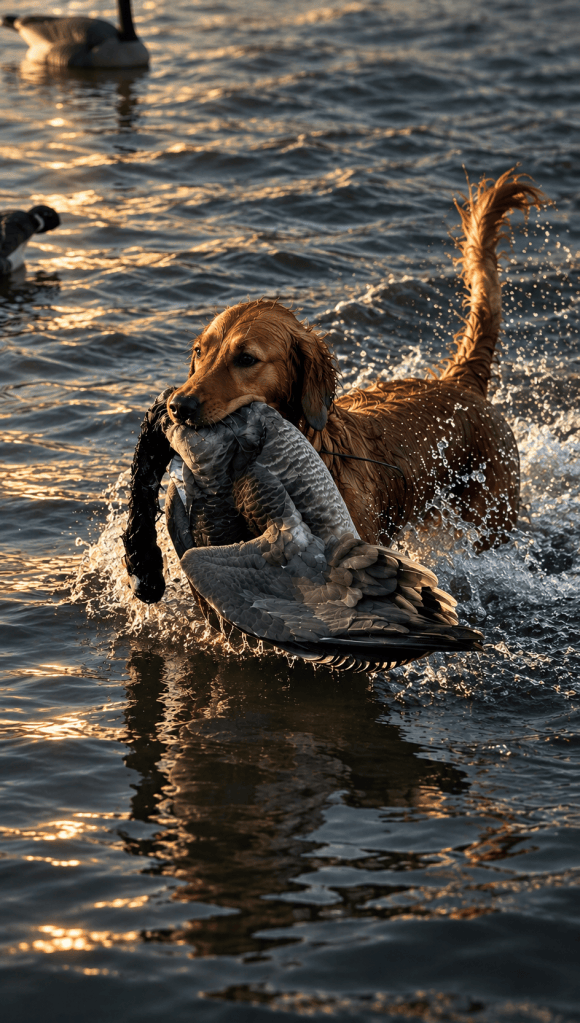
The birds are memorable. The hunts are unforgettable. But sometimes, the best part of waterfowl season is watching your dog become everything you hoped she’d be.
There’s something about watching a hunting dog finally put everything together that I don’t think you can fully explain to somebody who hasn’t experienced it.
You can spend countless hours training. Throw thousands of bumpers. Work on obedience, steadiness, marking, and handling until you’re blue in the face. You can study training programs, talk to experienced handlers, and convince yourself you’ve prepared your dog for everything the field might throw at her.
But then opening morning comes.
The guns go off, birds hit the water, and suddenly all those controlled training scenarios disappear.
Now it’s real.
And that’s where you find out what you’ve actually built.
For Danielle and me, one of the most rewarding parts of this waterfowl season hasn’t been the birds we’ve killed, the decoy spreads we’ve perfected, or the hunts that went exactly according to plan.
It’s been watching Ember.
Our two-and-a-half-year-old golden retriever has made more progress this season than I could have imagined. And while she’s still young, still learning, and certainly far from finished, something has changed.
The hesitant young dog that wasn’t quite sure what to think about a goose last year is disappearing.
In her place is a dog that genuinely wants to be part of the action.
And I’ll be the first to admit, watching that transformation has gotten me a little emotional.
A Year Ago, We Weren’t Here
One of the things I think people underestimate about developing a hunting dog is just how different individual dogs can be.
Some retrievers seem to come out of the womb ready to tackle anything with feathers.
Others take a little more time.
They need exposure. They need encouragement. They need to build confidence through experiences that make sense to them.
Ember has been one of those dogs.
Last year, she wasn’t exactly enthusiastic about picking up a Canada goose.
And honestly, I can understand why.
A full-grown honker is a pretty intimidating bird for a young golden retriever. It’s big, awkward, heavy, and nothing like the bumpers they’ve spent their lives retrieving.
It’s one thing to confidently carry a training dummy across the yard.
It’s another to grab a goose that might weigh a substantial portion of what you’re accustomed to carrying, especially when that goose isn’t necessarily interested in cooperating.
Last season, Ember would approach birds, investigate them, and occasionally give them a little bump.
She wasn’t completely unwilling.
She just hadn’t figured everything out yet.
And that’s an important distinction.
There’s a difference between a dog that doesn’t want to retrieve and one that simply doesn’t understand what you’re asking.
Looking back, I think Ember needed time and successful experiences more than anything.
We could have gotten frustrated.
We could have tried to force progress.
We could have compared her to other dogs that were further along at the same age.
But none of those things would have helped her become the dog we wanted.
So we kept working.
And this fall, something clicked.
Six Birds Down. Six Birds Retrieved.
Our first goose hunt of the season gave me a pretty good indication that things were going to be different.
It was a two-man hunt, and the morning started about as well as you could ask.
Six geese came in.
Six geese hit the ground.
And suddenly, Ember had some work to do.
She went out just like she was supposed to, approached the first goose, and gave it that familiar little bump.
I immediately thought we were about to relive last season.
I remember thinking, Oh shit. Here we go again.
I started getting my waders back on, fully expecting I’d need to go out and help her.
But before I could even get into the water, I looked up.
And there she was.
Halfway back with a goose.
Just carrying it like she’d been doing it her entire life.
I don’t know exactly what changed in her mind during those few seconds.
Maybe she’d finally developed enough confidence.
Maybe all those previous experiences had finally come together.
Or maybe she simply decided she was done messing around.
Whatever it was, I couldn’t believe what I was watching.
She didn’t just retrieve that first goose.
She kept going.
And going.
By the time the morning was over, we’d finished our two-man limit before 9:00.
Ten geese.
And Ember retrieved every single one of them.
I almost cried.
Not because we’d shot a limit.
We’ve had plenty of successful hunts over the years.
But because I knew how far she’d come to get there.
A year earlier, I would’ve been thrilled just to see her confidently pick up one goose.
Now she’d retrieved ten in a single morning.
That’s the kind of moment that reminds you why you put so much time into a dog.
Then Came the Goose That Fought Back
Of course, waterfowl hunting has a way of reminding you that confidence and experience aren’t the same thing.
A dog can have a fantastic morning retrieving cleanly downed birds and still encounter something completely different on the next hunt.
And Ember certainly did.
We had a crippled goose on the water.
Not one of those birds that’s barely moving and simply needs to be picked up.
I’m talking about a fully swimming, very much alive Canada goose that had absolutely no intention of being retrieved.
For a young dog, that’s a completely different challenge.
The bird is moving.
It’s trying to escape.
It’s big enough to fight back.
And once the dog gets close, there’s a real possibility of getting smacked around by wings.
Ember went after it.
And that goose gave her a fight.
It thrashed, resisted, and made the entire situation considerably more difficult than a normal retrieve.
But what impressed me most wasn’t simply that she kept working.
It was the determination she showed.
The same dog that was hesitant around geese a year earlier was now trying to figure out how to handle a bird that was actively fighting her.
She wasn’t looking for an excuse to quit.
She wanted to finish the job.
Ultimately, she got through it.
And when it was over, she went on to retrieve two more birds that day.
Then another two the following Saturday, including another crippled goose.
That one wasn’t quite as difficult, but it was another valuable experience.
Every successful retrieve adds something.
And every challenge gives us another opportunity to understand what she’s capable of and where she still needs help.
One thing I want to be clear about: there’s a difference between building confidence and putting a dog in unnecessary danger. A fighting goose can injure a retriever, particularly around the eyes. If a bird is presenting a serious risk, it’s our responsibility as hunters to intervene safely and dispatch wounded game promptly rather than expect the dog to win a fight.
I’m proud of Ember’s determination.
But I also want her hunting beside me for the next decade.
That means protecting her while she’s learning.
Confidence Is Built Through Experience, Not Just Repetition
Watching Ember this season has reinforced something I think every retriever owner should understand.
Training matters tremendously.
But training and experience aren’t interchangeable.
You can create an excellent foundation in the yard. You can develop obedience, build retrieving desire, teach marking, and introduce increasingly difficult scenarios.
But you can’t perfectly recreate every situation a dog will encounter during an actual hunt.
You can’t always predict where a goose will fall.
You can’t perfectly simulate the excitement of several birds hitting the water at once.
You can’t control how every cripple will behave.
And you certainly can’t recreate the entire atmosphere of a cold October morning with shotguns firing, birds calling overhead, decoys moving, and hunters trying to keep everything organized.
Those experiences have to be learned.
That’s why I think it’s so important to give young dogs opportunities to succeed without constantly overwhelming them.
For Ember, the progression has been incredible.
Last year, picking up a goose was a challenge.
This year, she’s developing the confidence to tackle multiple retrieves in a morning and work through situations that would’ve intimidated her before.
That doesn’t mean we’re finished training.
Far from it.
But it does mean the foundation is beginning to show up where it matters most.
In the field.
Five Things We’re Learning About Developing a Goose Dog
As Ember continues growing, there are several lessons I want to carry into the rest of this season and beyond.
1. Don’t rush a young dog’s development
It’s easy to watch videos of incredible retrievers and wonder why your dog isn’t performing at the same level.
But those short clips rarely show the years of training, mistakes, setbacks, and small victories that came before them.
Every dog develops differently.
Some mature quickly. Others need more time.
A hesitant young retriever isn’t automatically a bad retriever.
Sometimes they’re simply young.
The key is building a solid foundation and giving them appropriate opportunities to develop confidence.
2. Make early success as manageable as possible
A big Canada goose is a lot of bird.
For a dog that hasn’t developed confidence carrying large birds, starting with manageable retrieves can make a tremendous difference.
That might mean using appropriately sized training bumpers, gradually introducing larger retrieving objects, and working with safely handled dead birds in controlled training situations.
The goal is to help the dog understand the task without creating unnecessary frustration.
As confidence develops, the challenges can increase.
And when something goes wrong, there’s nothing embarrassing about making the next retrieve easier.
3. Don’t let excitement destroy steadiness
This is one of those things that’s easy to talk about and considerably harder to practice when birds are finishing.
A retriever that loves the job can become increasingly excited as it gains experience.
That’s fantastic.
But enthusiasm still needs to be controlled.
We want Ember watching birds, marking falls, and waiting until she’s released.
Not launching herself out of the blind every time somebody raises a shotgun.
Steadiness is particularly important around water, multiple hunters, and wounded birds.
A dog that waits for direction is safer and easier to handle.
And it gives us a much better chance of making the right decisions when a retrieve becomes complicated.
4. Learn when your dog needs help
There’s a temptation to let a young dog struggle because we want it to figure things out independently.
Sometimes a little problem-solving is beneficial.
But there needs to be a limit.
If a dog is becoming exhausted, confused, or physically threatened by a wounded bird, we need to intervene.
The goal isn’t to prove how tough the dog is.
It’s to build a capable retriever that trusts its handler and remains safe.
A successful training experience doesn’t always mean the dog completed every part of the task without assistance.
Sometimes good handling means recognizing when the situation has gone beyond what the dog is ready for.
5. Pay attention to the little victories
This might be the biggest lesson Ember has taught me.
Progress doesn’t always look dramatic.
Sometimes it’s a dog carrying a goose five yards farther than she did last week.
Sometimes it’s holding steady while birds land in the decoys.
Sometimes it’s confidently entering cold water.
Sometimes it’s simply approaching a large bird without hesitation.
Those moments are easy to overlook when we’re focused on filling limits.
But they’re the building blocks of the dog we’re trying to develop.
And occasionally, all those little victories come together in one incredible morning.
Like ten geese retrieved before 9:00.
The Golden Retriever Difference
I’ve said something for years that I still believe captures part of what makes hunting with a golden retriever so special.
Labs retrieve because they love it. Goldens retrieve because they love you.
Now, before every Labrador owner comes after me, I know that’s an oversimplification.
There are plenty of Labs that would do absolutely anything for their owners, and plenty of Goldens that are completely obsessed with retrieving.
Both breeds have produced incredible working dogs.
But there’s something about the relationship I have with Ember that makes that saying feel true to me.
She wants to work.
She wants to be involved.
And there’s something incredibly rewarding about watching her look back at me after a successful retrieve.
Maybe I’m reading too much into it.
Maybe she’s just excited about doing the job.
But I can’t help feeling like we’re accomplishing something together.
And that’s the part of hunting with a dog that means the most to me.
It’s not about owning the most talented retriever.
It’s not about having a dog that never makes mistakes.
It’s about developing a partnership over years of shared experiences.
The early mornings.
The long walks.
The missed birds.
The great retrieves.
The frustrating training sessions.
The moments when everything finally clicks.
All of it becomes part of the relationship.
And that relationship is something I wouldn’t trade for anything.
The Next Several Years Are What Excite Me Most
Here’s the crazy part.
Ember is only two and a half years old.
That’s it.
She’s still incredibly young.
She’s still developing physically and mentally.
She’s still learning how to read situations, handle different birds, and work through challenges.
And as proud as I am of what she’s accomplished this season, I know there’s so much more ahead of us.
That’s what gets me excited.
Imagine where she’ll be at four.
Or six.
Or eight.
Imagine the experience she’ll have after several more seasons chasing ducks and geese across Minnesota.
The retrieves she’ll make.
The situations she’ll learn to handle.
The confidence she’ll develop.
The memories we’ll make.
I know there will be frustrating days.
There will be missed marks, difficult retrieves, and moments when I question whether we’re making progress.
That’s part of training a dog.
But there will also be mornings when she does something that completely blows me away.
And I can’t wait to experience them.
Danielle and I have spent years building Burley Outdoors around the experiences we share outside.
The hunting.
The fishing.
The adventures.
The people.
And now, watching Ember develop has added another layer to all of it.
She’s not just another piece of hunting equipment.
She’s part of our family.
And she’s becoming one hell of a hunting partner.
Sometimes the Best Part of the Hunt Doesn’t Have Feathers
I think about that first goose hunt a lot.
Six birds dropping right away.
Ten birds in the bag before 9:00.
A morning that would’ve been memorable regardless of what happened next.
But when I look back, the thing I remember most isn’t the shooting.
It’s Ember.
I can still picture her swimming back with that first goose.
The moment I realized she wasn’t going to need my help.
The excitement of watching her retrieve bird after bird.
And the overwhelming pride I felt when the morning was over.
That’s what sticks with me.
Not the number of birds.
Not the size of the spread.
Not whether everything went perfectly.
Just a boy and his dog.
Learning together.
Growing together.
Making memories that will mean a whole lot more someday than any limit of geese ever could.
And when I think about how far she’s come in just one year, I can’t help getting a little emotional.
Last season, she wasn’t sure she wanted anything to do with a goose.
This season, she’s becoming the dog I always hoped she’d be.
The best part? We’re just getting started.
– Max & Danielle
Burley Outdoors


Leave a Reply