
Burley Outdoors | November 17, 2026
At some point during waterfowl season, you have to ask yourself a serious question.
How many decoys is too many?
Apparently, our answer is somewhere north of 300.
We’ve spent a lot of this season talking about simplifying things.
Smaller spreads. Less equipment. Walking into overlooked locations with a dozen decoys and Ember. Trying to outsmart pressured birds without hauling half the garage into the marsh.
And honestly, I love that style of hunting.
But sometimes you’ve got to throw everything you think you know out the window and try something completely different.
So that’s exactly what we did.
We put roughly 25 dozen decoys on the water and attempted to create what we started calling our mini refuge.
Not just a big duck spread.
Not just a goose spread with some ducks mixed in.
An entire mixed-species waterfowl concentration.
Mallards, black ducks, teal, wigeon, gadwall, pintails, divers, geese, and enough motion decoys to make the water look like somebody had turned on a giant washing machine.
And when we finally got the drone in the air and looked down at everything we’d built, I had to admit something.
It looked pretty damn impressive.
Whether the birds thought the same thing was an entirely different question.
Why We Built the Mini Refuge
If you’ve been following our hunts this fall, you already know the story.
These November birds have been making us work.
We’ve had ducks and geese show interest, change direction, and even start working the decoys, only to slide off and continue toward wherever they originally intended to go.
And on some of these low-wind days, getting birds to break their flight lines has been especially challenging.
We’ve tried smaller spreads.
We’ve adjusted motion.
We’ve experimented with calling.
We’ve changed our hides and moved decoys more times than I care to admit.
But for this hunt, we wanted to try something different.
Instead of trying to imitate a small group of birds using a particular spot, we wanted to make the entire shoreline look like a place waterfowl had already decided was worth spending time.
Think about the places you find large concentrations of birds while scouting.
The protected shorelines.
The quiet backwaters.
The areas where ducks and geese seem perfectly comfortable loafing, feeding, and moving around.
Those locations don’t always have birds sitting in one perfectly organized group.
They have pockets of birds.
Different species.
Different densities.
Some feeding.
Some resting.
Some swimming around.
And others scattered farther into open water.
That’s the look we were trying to recreate.
We weren’t simply trying to attract birds to a decoy spread.
We were trying to convince them they had found an established waterfowl concentration.
The Location Made the Entire Concept Possible
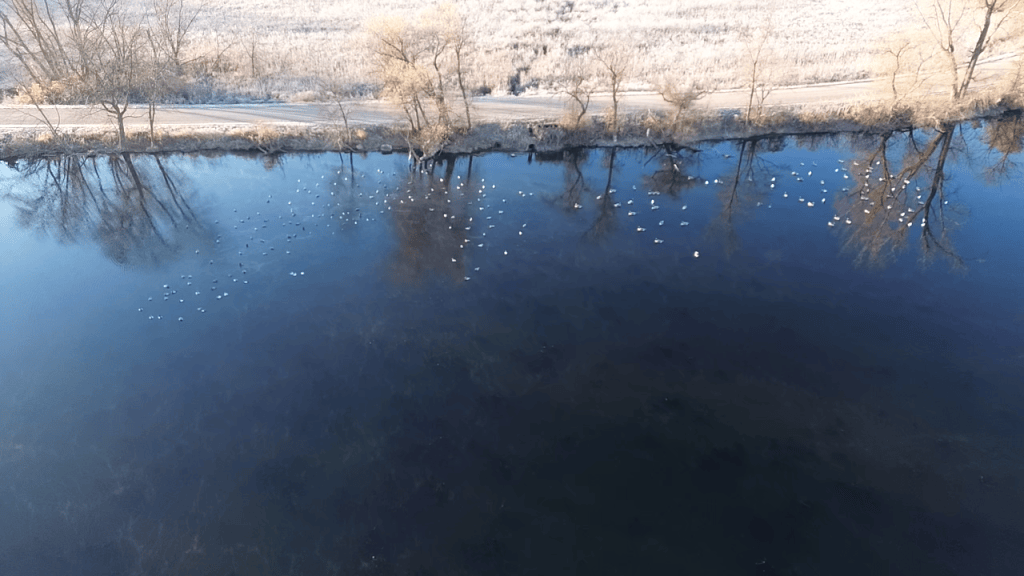
Looking at the drone footage, one of the first things that stands out is the shoreline.
We had a long, relatively protected stretch of water with trees, brush, and vegetation running along the bank.
Behind it was a narrow road and open ground.
Out in front was a much larger body of water.
That combination gave us something important.
Room.
A lot of it.
Instead of squeezing everything into one small opening, we could distribute decoys across a substantial section of shoreline and extend portions of the spread into deeper, more open water.
And that’s exactly what the aerial pictures show.
From above, the decoys don’t form one perfectly symmetrical shape.
They’re spread across multiple concentrations.
Some groups are tucked closer to the shoreline.
Others extend farther out.
And there’s a noticeable amount of open water between different sections.
That was the entire point.
We wanted the setup to look like birds had naturally selected this area rather than somebody had dumped 300 decoys into one giant pile.
The shoreline was our foundation
The trees and brush along the bank created a natural boundary.
And I think that helped the overall appearance.
A concentration of birds using protected shoreline water makes sense.
Especially during November when wind, weather, and hunting pressure can influence where birds choose to spend their time.
Rather than making the spread look like one giant raft floating in the middle of nowhere, we were able to use the shoreline as part of the presentation.
From the drone, the decoys appear to follow the natural shape of the bank before spreading farther into the open water.
That made the whole thing look more like a concentration using the habitat than a traditional hunting spread.
Breaking Down the 300-Decoy Arsenal
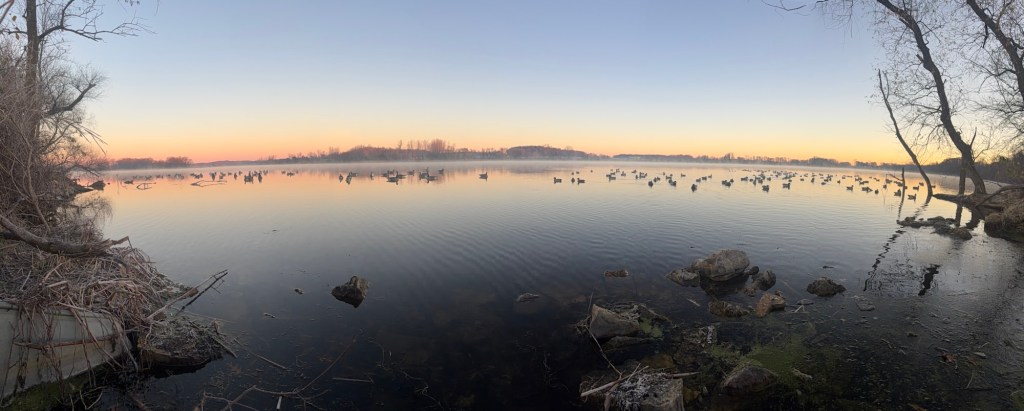
Here’s what we actually put into this thing.
And yes, it’s a ridiculous amount of equipment.
Puddle ducks and divers
Species
Number
Mallards: 60
Black ducks: 12
Teal: 36
Wigeon: 12
Gadwall: 12
Mixed divers: 24
Pintails: 12
Total duck decoys: 168
That’s 14 dozen regular duck decoys.
A pretty respectable spread by itself.
But we were just getting started.
Motion decoys
We added another 24 decoys using a combination of swimmers, Power Kickers, shakers, and pulsators.
Those weren’t just there for decoration.
We wanted them to create different types of movement throughout the spread.
Goose decoys
Then came seven dozen goose decoys.
Plus another two dozen goose butts.
That’s 108 goose decoys.
All together?
300 decoys. Exactly 25 dozen based on our inventory count.
And that doesn’t include the amount of patience required to put everything out and pick it all back up.
I don’t think anybody makes a decoy bag big enough for that.
What the Drone Pictures Reveal
This is where the setup gets interesting.
Standing on shore, you can see a lot of decoys.
But you can’t fully appreciate how the entire spread is arranged.
Once the drone gets above everything, the layout becomes much clearer.
And there are a few things I really like about what we created.
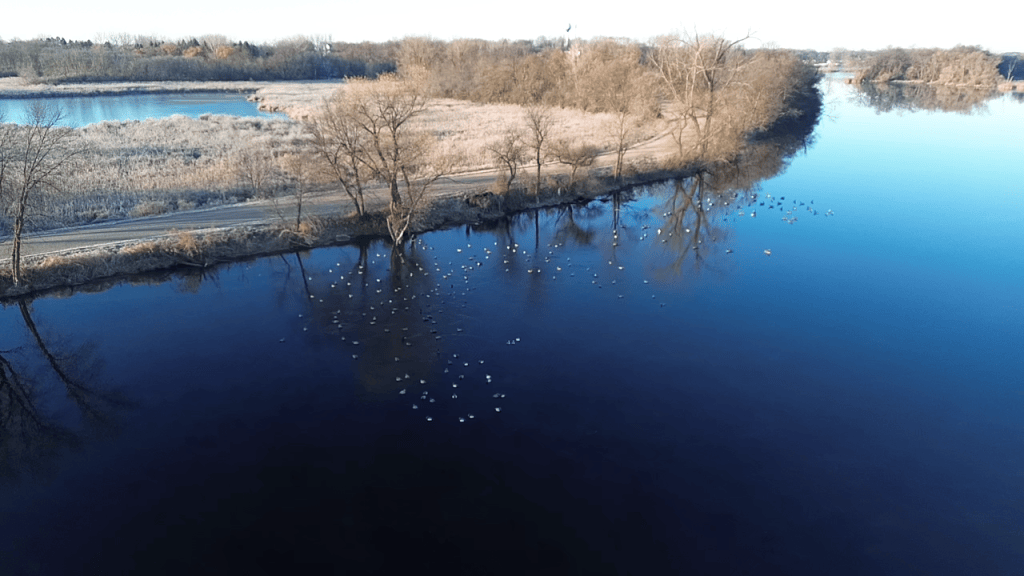
1. We had multiple concentrations instead of one giant mass
In the aerial pictures, you can see the decoys arranged in different groups along the shoreline.
There’s a substantial concentration toward the middle of the setup.
Additional groups extend farther along the bank.
And smaller pockets of birds are scattered toward open water.
That gives the spread some depth.
Instead of one solid wall of decoys, birds approaching from different directions would see several groups occupying the same general area.
That’s much closer to the look we were after.
2. We left a surprising amount of open water
This might be my favorite part of the setup.
Despite having 300 decoys, the spread doesn’t completely overwhelm the water.
There are significant openings between groups.
And when you look at the wider drone picture, there’s still an enormous amount of open water surrounding everything.
That matters.
Because one of the biggest mistakes you can make with a large spread is assuming every decoy needs to be packed tightly together.
Real birds don’t always sit shoulder to shoulder.
They spread out.
They create smaller groups.
They move around.
And they leave gaps.
The open water helped make the whole scene feel less crowded.
It also gave us areas where approaching birds could potentially find room to land.
Of course, creating an opening and getting birds to use it are two very different things.
But at least we weren’t asking them to land on top of 300 plastic birds.
3. The spread followed the shoreline
Another thing that stands out is how the decoys occupy the water along the bank.
The overall concentration stretches horizontally rather than forming one narrow column.
That creates a much larger visual footprint.
And I think that’s one of the biggest advantages of this style of setup.
We’re not relying on birds noticing one small group.
We’re creating an entire section of shoreline that looks occupied.
The hope is that birds traveling across the lake notice the concentration and decide it’s worth investigating.
4. The motion was visible from above
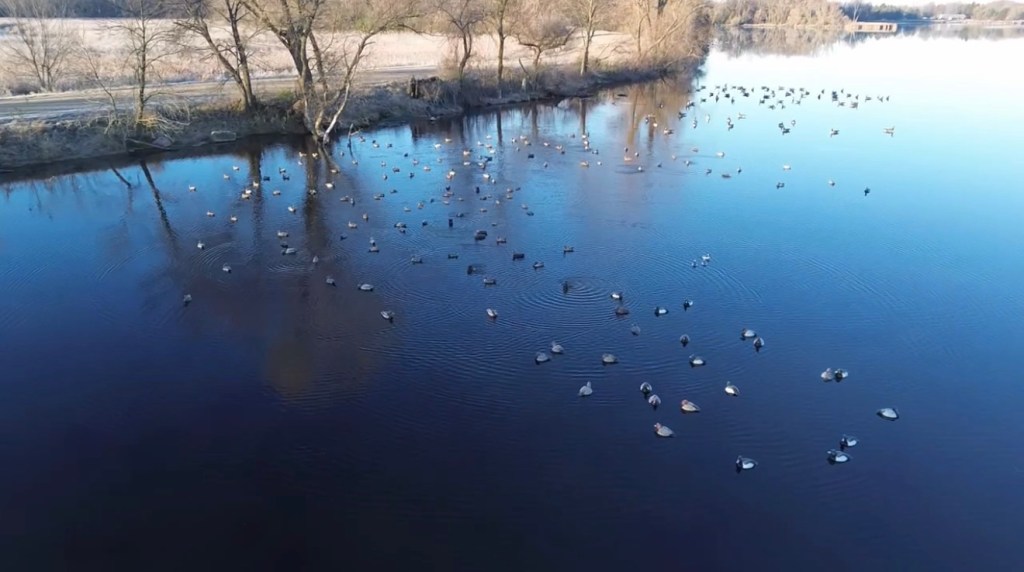
In the closer drone images, you can see circular ripples spreading outward from different points in the water.
That’s exactly what we wanted the motion decoys to accomplish.
When the wind is light, a large number of stationary decoys can look surprisingly lifeless.
But those ripples help break up the flat surface.
They create movement between decoys.
And they give the impression that birds are doing something other than sitting perfectly still.
What I particularly like is that the movement isn’t concentrated in one tiny area.
There are multiple points of disturbance.
That makes the activity feel more distributed across the spread.
Now, whether we had the ideal amount of motion is something we’d need to judge by how birds responded.
But visually, the drone footage shows that the motion was doing its job.
Why We Mixed So Many Species
One of the biggest differences between this spread and a traditional duck setup was the variety.
We weren’t just running mallards.
We had seven different duck categories represented, plus geese.
And I think that variety contributed a lot to the overall appearance.
Mallards were the backbone
Five dozen mallards gave us enough birds to establish substantial groups.
They’re familiar, recognizable, and fit naturally into a mixed-species waterfowl concentration.
But we didn’t want every decoy to have the same shape or color.
Black ducks added contrast
The dozen black ducks brought darker bodies into the mix.
From a distance, that creates some visual variation among the other puddle ducks.
And in a spread this large, I like having those differences.
Teal created smaller groups
Three dozen teal added another size class.
And with green-wings finally showing up in our area, teal have been a big part of what we’ve been paying attention to lately.
Their smaller profiles help break up the overall appearance.
Wigeon, gadwall, and pintails added variety
A dozen each of wigeon, gadwall, and pintails rounded out the puddle duck spread.
Different body shapes.
Different colors.
Different silhouettes.
The goal wasn’t to make every species perfectly recognizable from a mile away.
It was to avoid having the entire spread look identical.
Divers extended the open-water appearance
The two dozen mixed divers helped represent birds using the more open portions of the water.
That’s an important part of the overall refuge concept.
We weren’t trying to make every duck look like it was feeding in six inches of water along the bank.
We wanted different groups occupying different parts of the habitat.
And the divers helped create that impression.
The Goose Spread Wasn’t an Afterthought
Nine dozen goose decoys is a substantial spread all by itself.
But in this setup, they were part of a much bigger picture.
Seven dozen regular goose decoys gave us a strong visual presence.
Then we added two dozen goose butts to create the appearance of birds actively feeding.
And I think those feeding postures are important.
When you watch real geese using shallow water, they aren’t all sitting upright doing exactly the same thing.
Some are resting.
Some are swimming.
Some are alert.
Others are feeding with their heads underwater.
That’s what the goose butts help represent.
And when you combine that with a large number of ducks, the overall setup starts to look like a place where multiple species have found something they like.
That’s the refuge illusion.
Not just a bunch of birds.
A bunch of birds that appear comfortable enough to stay.
Two Dozen Motion Decoys Might Sound Insane
And maybe it is.
But hear me out.
One of the problems we’ve been dealing with this season is low wind.
And low wind can be brutal when you’re trying to make a large spread look natural.
Decoys sit still.
The water turns into a mirror.
And suddenly your beautiful spread looks like somebody arranged a bunch of plastic ducks on a sheet of glass.
That’s where motion becomes important.
We used a combination of swimmers, Power Kickers, shakers, and pulsators.
Swimmers created movement
Swimmer decoys helped introduce the appearance of birds moving through the water.
That adds a different type of motion than a decoy simply vibrating or splashing in place.
Power Kickers disturbed the surface
Power Kickers helped create water movement.
On calm days, that disturbance can be especially noticeable.
Shakers added localized activity
Shakers provided movement in different areas without requiring every decoy to travel.
Pulsators created additional ripples
Pulsators helped create more surface disturbance.
And looking at the drone pictures, those ripple patterns are clearly visible.
Why not just use one type?
Because real birds don’t all move the same way.
Some swim.
Some feed.
Some splash.
Some rest.
And some barely move at all.
By mixing different motion systems, we were trying to create a more varied presentation.
The goal wasn’t to make every decoy move.
It was to make the overall concentration feel alive.
The Challenge of Pulling Birds Off Their Flight Line
This was the real reason we went through all the trouble.
We weren’t just trying to build something that looked impressive on camera.
We wanted pulling power.
We’ve dealt with plenty of birds this season that seem completely committed to their own plans.
They know where they’re going.
They’ve been pressured.
And they’re not particularly interested in changing direction just because we put out some decoys.
So the idea behind the mini refuge was to create something they couldn’t easily overlook.
A large concentration.
Multiple species.
Movement throughout the spread.
A substantial footprint along the shoreline.
Something that might convince a passing flock to at least take a second look.
But there’s an important distinction here.
Getting birds to look at a spread isn’t the same as getting them to finish.
And this is where big spreads can become frustrating.
You might attract attention from a long distance.
You might even convince birds to alter their flight path.
But if they decide to land outside your intended shooting area, you’re still left watching them do exactly what you didn’t want.
That’s why I don’t believe the answer is simply adding more decoys.
The size has to serve a purpose.
And the layout still needs to give birds a reason to finish where you want them.
The Problem With Creating Your Own Refuge
Here’s the funny thing about trying to imitate a refuge.
A real refuge is attractive partly because birds can use it without being constantly disturbed.
Our version had hunters sitting nearby waiting for an opportunity.
Slight difference.
And that’s something worth thinking about.
We can imitate the visual appearance of a large concentration.
We can create movement.
We can use different species.
We can position decoys along natural habitat.
But we can’t completely recreate the behavior of hundreds of real birds.
And we certainly can’t guarantee that passing ducks and geese will believe what they’re seeing.
They still have to make the decision.
That’s why I view this as an experiment.
We’re testing a concept.
Trying to understand what gets pressured birds to investigate.
And learning whether a large mixed-species presentation gives us an advantage over more traditional spreads.
Was It Worth Hauling Out 300 Decoys?
That’s the million-dollar question.
And honestly, the answer depends on what you’re trying to accomplish.
If the goal is simply to get out for a quick morning hunt, absolutely not.
I’d rather grab a dozen decoys, load up Ember, and head into a little marsh.
But if the goal is to create a major visual attraction on a large piece of water?
Now we’re talking.
There are situations where a big spread might make sense.
Especially when birds are traveling across expansive water and visibility becomes a major consideration.
The mini refuge gave us a completely different presentation than our small walk-in setups.
And that’s what I like about it.
We aren’t married to one style of hunting.
Some days we want to be mobile.
Some days we want to be subtle.
And sometimes we want to turn an entire shoreline into a fake waterfowl sanctuary.
It’s all about choosing the right approach for the situation.
What I’d Change or Watch Next Time
Looking at the aerial pictures, there are a few things I’d pay especially close attention to if we ran this setup again.
Watch where birds naturally want to land
The spread has multiple groups and plenty of open water.
But the birds will ultimately tell us which portions of the layout they prefer.
If they consistently favor one edge, that matters.
If they try to land outside the intended opening, that matters too.
Evaluate the motion
The ripples look good from above.
But I’d want to know whether birds responded positively to that much activity.
There’s a balance between making a spread look alive and making it look unnatural.
Pay attention to the overall footprint
The spread covers a substantial section of shoreline.
That’s great for visibility.
But it also creates a large area where birds might decide to approach.
I’d want to evaluate whether the layout helped funnel birds toward our intended shooting area or gave them too many options.
Decide whether every decoy earned its place
This might be the hardest one.
Because after hauling 300 decoys out there, nobody wants to admit that 200 might have done the same job.
But that’s the kind of question worth asking.
Did the extra decoys improve the presentation?
Or did they simply add more work?
That’s something we can only answer by comparing how birds respond across different hunts and conditions.
The Biggest Lesson: Think Beyond the Landing Hole
One of the things I like most about this experiment is that it forced us to think about the entire scene.
Not just the landing pocket.
Not just the wind direction.
Not just where we wanted birds to finish.
But what a passing flock would see from a distance.
Would the shoreline look occupied?
Would the different groups appear natural?
Would the motion make the water look active?
Would the spread be visible enough to get birds to change direction?
And if they came over for a look, would they find a place they wanted to land?
Those are all important questions.
And they’re questions worth asking whether you’re running 300 decoys or 12.
Because the principle is the same.
Don’t just throw decoys out and hope birds like them. Build a setup that makes sense for the location and the birds you’re trying to hunt.
Sometimes You Just Have to Go All In
I’ll admit it.
There’s something pretty satisfying about seeing 300 decoys floating on the water.
Especially when you get the drone up and see the whole thing from above.
All those different species.
The groups scattered along the shoreline.
The motion creating ripples.
The open water between concentrations.
It’s a pretty cool sight.
And it represents a lot of planning, preparation, and work.
But what I like most is the willingness to experiment.
We’ve had mornings this season where a tiny spread was the right answer.
And we’ve had mornings where we’ve felt like we needed to do something completely different to get these birds interested.
That’s waterfowl hunting.
You try something.
You watch how the birds respond.
You learn.
And you make adjustments.
Sometimes the simplest setups are the most effective.
Sometimes a big spread gives you an advantage.
And sometimes you spend hours putting out 300 decoys just to remind yourself that ducks and geese are perfectly capable of ignoring every single one of them.
But I’d rather keep experimenting than spend the rest of the season doing the exact same thing and wondering why nothing changes.
Because the whole point is to become better hunters.
Better at reading birds.
Better at understanding locations.
Better at adapting to pressure.
And better at recognizing when a different approach might give us an opportunity.
For this hunt, that different approach happened to involve 25 dozen decoys.
A mini refuge.
A whole lot of motion.
And enough equipment to make me question my life choices while picking everything back up.
Would I do it again?
Under the right conditions, absolutely.
But I’m also pretty sure Ember wouldn’t complain if the next hunt involved about 288 fewer decoys.
– Max
Burley Outdoors


Leave a Reply